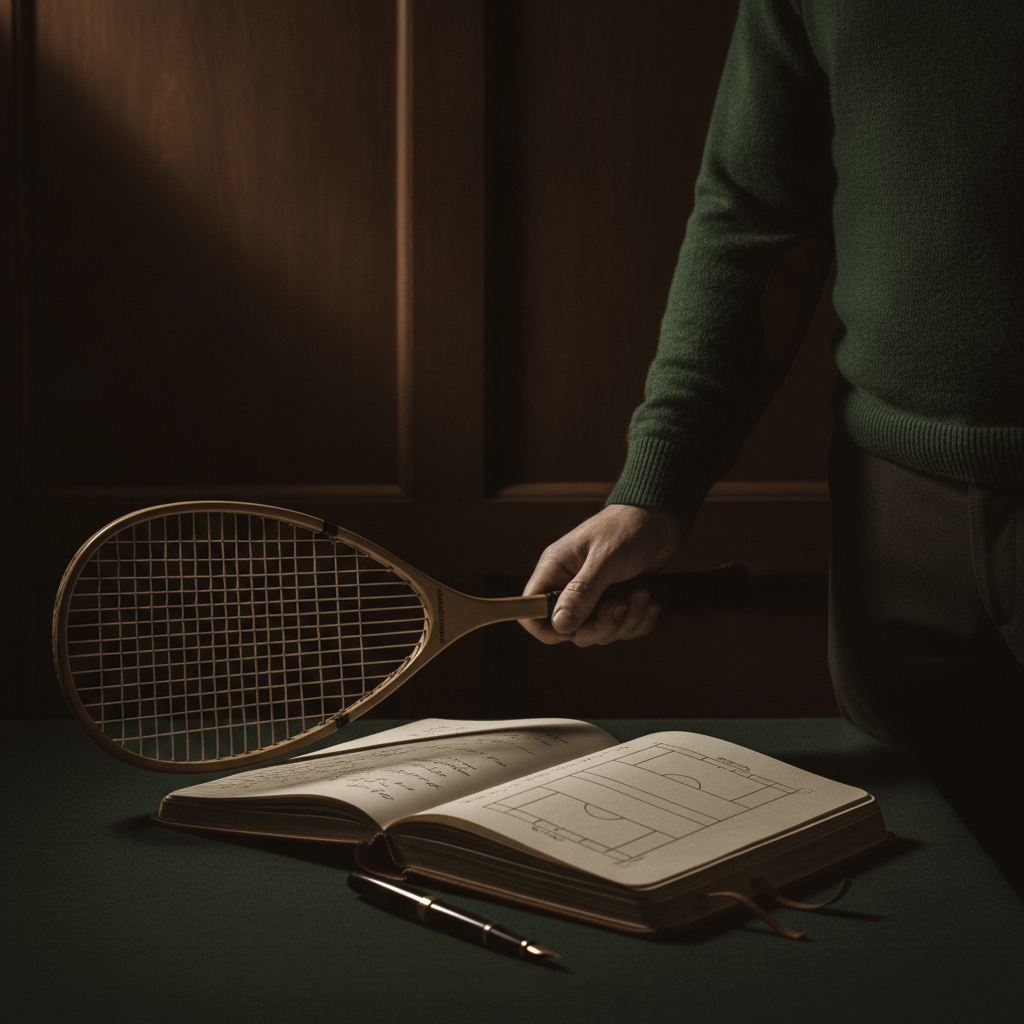
The drop shot is, at its finest, an act of considered cruelty. Not the violent cruelty of the thunderous drive or the cross-court lash — but the slow, deliberate cruelty of a man who knows precisely where the rally has arrived, and chooses that moment to place the ball two inches above the tin at an angle so tight that his opponent, already retreating toward the T, will cover the distance to the front left corner in time only to watch it die. The drop shot does not require power. It requires poise. And poise, as every experienced squash player eventually discovers, is very much harder to acquire than power.
History and Philosophy
The drop shot has been a feature of squash since the sport’s earliest organisation in the 1880s, when players at Harrow School discovered that a ball placed close to the side wall and dying quickly was, essentially, unreachable. But the modern drop — the true attacking weapon — owes its development to the Pakistan squash dynasty of the 1950s through 1980s, in which Hashim Khan, Roshan Khan, and their successors turned what had been a defensive safety shot into an offensive instrument of extraordinary precision. The drop shot was no longer something you played when you were pinned in the back corners. It was what you played when you had earned the right to win the point on your own terms.
The mechanics are, in principle, straightforward. The racket face opens — that is, tilts back — at the moment of contact, taking pace off the ball and directing it toward the front wall at a steep downward angle. The ideal landing point is as close to the nick — the junction of the front wall and the floor — as the player’s nerve permits. A ball that dies in the nick cannot be retrieved. A ball that sits up, even a few inches above the tin, can. The difference between the two outcomes is measured not in centimetres but in degrees of wrist angle, contact point on the ball, and the particular quality of stillness that separates a controlled swing from a nervous one.
Deployment and the Ghost Variation
The question of when to play the drop shot is, in the long run, more important than the question of how. The most technically proficient drop in the world, played at the wrong moment, gifts your opponent an easy pick-up and a free shot at the back of the court. The correct moment is the one in which your opponent is behind you, moving toward or already on the T, and has committed his weight to reading a length shot. The tell is in the shoulders: a player expecting a drive to the back wall will lean slightly back; a player expecting a cross-court will shift his weight outward. The drop shot punishes both postures with equal efficiency, but it punishes them only when the player executing it has had the patience to wait for them.
The ghost variation — sometimes called the disguised drop or the deceptive drop — is the most advanced expression of this philosophy. Here, the backswing is identical to that of a length shot: full, deliberate, suggesting power. The drop is introduced only at the last possible moment, through a dramatic deceleration of the swing and a late opening of the racket face. Done correctly, the opponent commits to the length and is already moving backward when the ball dies at the front wall. Done incorrectly, it results in a short, slow shot with no disguise whatsoever, which is very nearly the worst possible squash one can play. The ghost drop is, therefore, not a beginner’s weapon. It is the product of a player who has internalised the mechanics so thoroughly that they no longer need to think about them — and can afford to think, instead, about their opponent.